
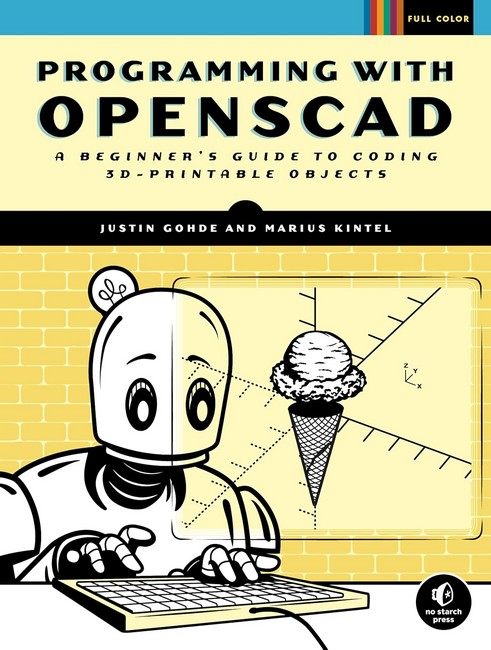
Programming with OpenSCAD: A Beginner's Guide to Coding 3D-Printable Objects. Marius Kintel, Justin Gohde
Код: LB-0022589
В наличии

Доставка
 Подписка на доставку SmartБесплатно — в отделения Новой почты
 Нова Пошта (Бесплатно при условии)
Оплата и гарантии
 Безопасная оплата картойБез переплат
Prom гарантирует безопасность
Вернем деньги при отказе от посылки Оплатить частямиБез переплат*, от 196 ₴/мес.
 Наложенный платежНова Пошта
 Оплата на счетIBAN UA413808050000000026007762985
Характеристики и описание
OpenSCAD is freely available open source software that enables nondesigners to easily create 3D designs using a text-based programming language. It’s a great language for beginners because the instant 3D visualization gives you immediate feedback on the results of your code. This book channels OpenSCAD’s visual benefits and user-friendliness into a STEAM-focused, project-based tutorial that teaches the basics of coding, 3D printing, and computational thinking while you develop your spatial reasoning by creating 3D designs with OpenSCAD.
Presuming no prior experience with either programming or 3D design, each chapter builds a scaffolded understanding of core concepts. You’ll start by defining, drawing and displaying geometric primitives with text-based code, then expand your creative toolbox with transformation operations – like rotating, reflecting, scaling, and combining shapes.
As the projects become more sophisticated, so will your programming skills; you’ll use loops for replicating objects, if statements for differentiating your designs, and parameterized, self-contained modules to divide longer scripts into separate files. Along the way, you'll learn 3D printing tips so that you can produce physical mementos of your progress and get physical feedback that lets you correct mistakes in real time. In addition, the book provides hands-on and accessible design exercises at the end of each chapter so that you can practice applying new concepts immediately after they are introduced.
You’ll learn:
- Programming basics like working with variables, loops, conditional statements, and parameterized modules
- Transformation operations, such as rotate, reflect, and scale, to create complex shapes
- Extrusion techniques for turning 2D shapes into elaborate 3D designs
- Computational-thinking concepts, including decomposition, abstraction, and pattern recognition
- OpenSCAD’s Boolean, Minkowski and hull operations for combining multiple 3D shapes into one
- 3D design fundamentals, like navigating the xyz-axis, orthogonal vs. perspective views, and constructive solid geometry
- Organizing bigger designs into separate files to make code more readable and collaborative
Accessibly written for a wide audience (advanced middle schoolers, high school students, college students, artists, makers and lifelong-learners alike), this is the perfect guide to becoming proficient at programming in general and 3D modeling in particular.
About the Author
Marius Kintel is the primary author and maintainer of OpenSCAD. He is a software engineer with more than 20 years of professional experience in diverse fields such as 3D visualization, physical computing, manufacturing automation, and cloud computing. In 2007, he became involved in the RepRap project out of an interest in learning electronics and the opportunity to transfer his knowledge of 3D graphics into the creation of tangible objects. Together with the rest of the local RepRap team at the Metalab hackerspace in Vienna, Austria, OpenSCAD was created out of a need for an open-source multi-platform design tool more suitable for 3D printing. The project was adopted by the maker community at large, and has since grown to become one of the most popular open-source 3D modeling tools for 3D printing.
Justin Gohde has been teaching Math and Computer Science for more than 20 years. He is the Head of Computer Science at Trinity School in Manhattan, New York where he oversees the Computer Science curriculum and programs, including a Design Lab makerspace with a wide collection of rapid prototyping tools for supporting Computer Science, Robotics, and other STEAM-focused projects.
[test]
Отзывы и вопросы
- Отзывы (0)
- Вопросы (0)
Еще не было отзывов об этом товаре


